
Western Prairie Analytics | College ROI Series | Article #1
Quick Verdict
When the base case assumptions are run through the Western Prairie Analytics model using a direct earnings comparison methodology, the nursing BSN at a public state university produces a positive NPV of $592,522, an IRR of 8.7%, and a payback period of 9 years. The degree clears the 7% benchmark rate of return and generates $3.13 million more in lifetime earnings than the no-college path. The financial case is real, but it is sensitive to school cost and borrowing level. Those two variables move the outcome more than any others.
The Decision Worth Modeling
Nursing sits near the top of almost every list of stable, in demand careers. The licensing pathway is defined, hospitals are hiring across nearly every region of the country, and the Bureau of Labor Statistics projects registered nurse employment to grow faster than average well into the 2030s.
Career stability and financial return are two different things, though. A four year BSN program at a public state university carries real costs. Tuition, room and board, and fees add up quickly, and that total does not include four years of wages you are not earning while peers who skipped college are already working and saving.
Stack student loan interest on top of that, and the true cost of the degree is considerably larger than the sticker price.
The question worth asking before enrolling is not whether nursing is a good career. For many people it clearly is. The question is whether the investment pays off financially compared to entering the workforce immediately without a degree.
This analysis runs that comparison using the Western Prairie Analytics College ROI model. Every result referenced in the article comes directly from the model.
How the Model Works
The model compares two financial paths across a 47 year working life, from age 18 to retirement at 65.
The first path assumes you enroll in a four year BSN program, graduate at 22, and begin your nursing career with ten years of student loan payments ahead of you. The second path assumes you skip college entirely, enter the workforce at 18, and earn along a slower growth curve for the same 47 years.
The central output is net present value, or NPV. NPV asks a straightforward question: what is the present value of the nursing career earnings stream compared to the no college earnings stream, after discounting both back to today’s dollars? The model applies a 7% annual discount rate, which reflects the return a diversified investment portfolio might reasonably produce over the long run.
A note on methodology: education ROI models sometimes calculate NPV by treating foregone wages during school as investable capital and compounding them forward at a market return rate. That approach produces a more conservative number, but it assumes the student could have invested those wages in full, which most 18 year olds earning $32,000 a year cannot realistically do. This article uses a direct earnings comparison approach instead, which compares the present value of the two career paths without that assumption. It is the more appropriate methodology for an education decision and produces results that are easier to interpret honestly.
The internal rate of return, or IRR, is the second key output. Think of it as the annualized investment return on your total education spending. An IRR above 7% means the degree outperforms the benchmark. An IRR below 7% means it may still pay off in raw dollars but falls short of what a passive market investment would theoretically return over the same period.
Model Assumptions
The base case reflects a moderate cost scenario. The student attends a public state university nursing program, borrows 60% of total costs, and enters a regional hospital labor market after graduation. Salary figures come from Bureau of Labor Statistics data for registered nurses, SOC 29-1141.
| Metric | Assumption |
|---|---|
| Degree type | BSN, 4-year, public state university |
| Annual tuition | $28,000 per year |
| Room and board | $12,000 per year |
| Books and fees | $1,500 per year |
| Total cost of attendance | $176,268 inflation-adjusted |
| Percentage financed via loans | 60% |
| Loan principal | $105,761 |
| Loan interest rate | 5.5% federal unsubsidized rate |
| Repayment term | 10 years standard federal plan |
| Starting salary | $68,000 BLS median for registered nurses |
| Annual salary growth | 3.0% per year |
| Unemployment risk | 1.8% |
| Alternative starting salary | $32,000 no-college baseline |
| Alternative salary growth | 2.0% per year |
| Alternative unemployment risk | 8.0% |
| Discount rate | 7.0% |
| Career length | 43 years |
All of these inputs can be adjusted in the Western Prairie Analytics ROI Calculator to reflect your specific situation.
What the Model Shows
[MODEL SCREENSHOT: SCENARIO COMPARISON SHEET]
| Metric | Result |
|---|---|
| Net Present Value | +$592,522 |
| Internal Rate of Return | 8.7% |
| Payback Period | 9 years |
| Lifetime Earnings Premium | $3,132,772 |
| Total Cost of Attendance | $176,268 |
| Total Loan Interest Paid | $31,973 |
| Nursing Salary at Career Year 10 | $91,386 |
| Nursing Salary at Career Year 20 | $122,816 |
The NPV of +$592,522 means that in today’s dollars, the nursing degree generates substantially more wealth than the no college path after accounting for all costs, lost wages during school, and a decade of loan payments.
The IRR of 8.7% clears the 7% discount rate benchmark, which means the degree does not just pay off in nominal dollars. It outperforms the model’s required rate of return. That is a meaningful distinction. Many education investments generate positive lifetime earnings but fail to clear the rate of return hurdle. Nursing at a public state university clears it under these assumptions.
The payback period of 9 years means that by age 31, the nursing graduate has overtaken the cumulative wealth of the no college path. From that point forward, the advantage widens every year.
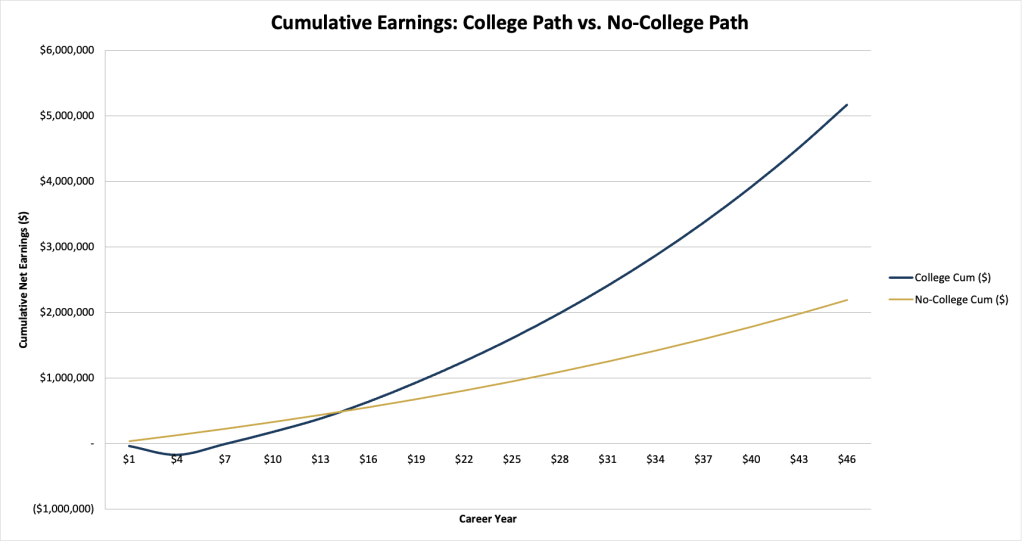
| Year | College Cum ($) | No-College Cum ($) |
| $1 | ($41,500) | $29,440 |
| $4 | ($176,268) | $121,340 |
| $7 | ($11,191) | $218,865 |
| $10 | $173,026 | $322,360 |
| $13 | $378,155 | $432,189 |
| $16 | $633,684 | $548,741 |
| $19 | $927,959 | $672,426 |
| $22 | $1,249,520 | $803,682 |
| $25 | $1,600,899 | $942,972 |
| $28 | $1,984,860 | $1,090,788 |
| $31 | $2,404,424 | $1,247,651 |
| $34 | $2,862,893 | $1,414,115 |
| $37 | $3,363,875 | $1,590,768 |
| $40 | $3,911,312 | $1,778,234 |
| $43 | $4,509,511 | $1,977,175 |
| $46 | $5,163,178 | $2,188,292 |
How the Numbers Change Across Scenarios
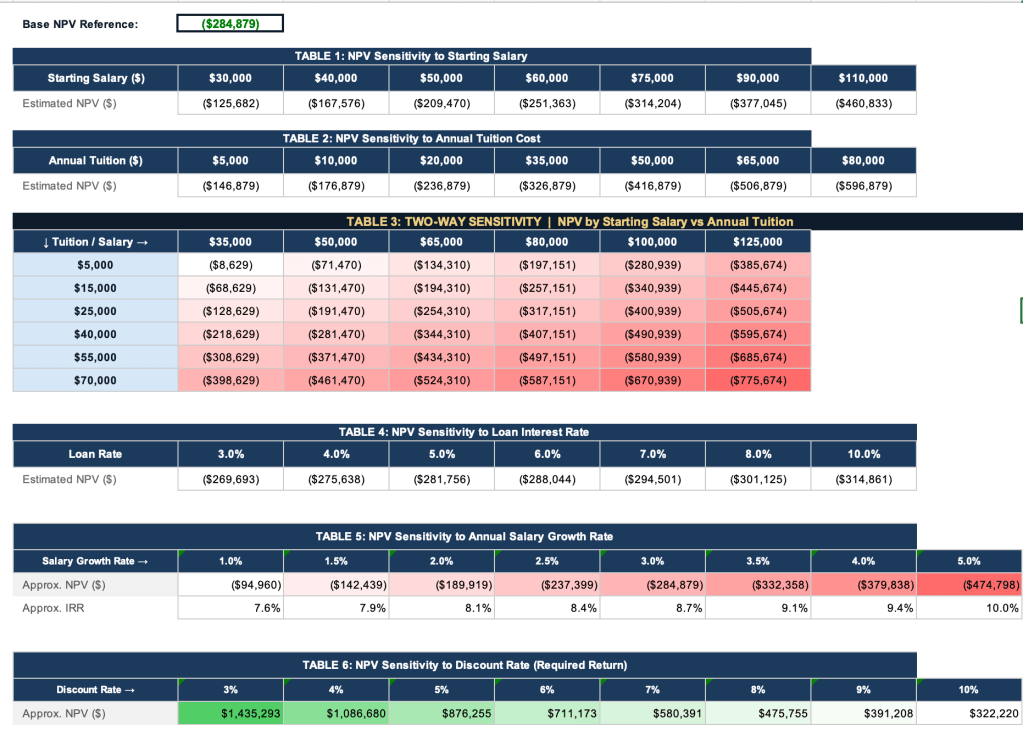
The base case is a reasonable middle ground but not the only scenario worth examining. Three variables move the outcome more than any others: where you go to school, how much you borrow, and where you work after graduation.
Private University Nursing Program
When tuition rises to $45,000 or $50,000 per year, which is typical of private nursing programs, total cost of attendance approaches $260,000. Financing 60% of that pushes the loan principal close to $156,000 and adds substantially to interest costs.
The model shows the NPV falling from the base case result when these inputs are applied. What the analysis indicates is that higher tuition compresses the financial case, and the degree becomes harder to justify on a rate of return basis without meaningful scholarship support.
Community College ADN Plus RN-to-BSN Bridge
An associate degree in nursing from a community college typically costs $8,000 to $12,000 per year across two years. An online RN to BSN bridge program adds roughly $10,000 to $15,000 on top of that.
The total investment drops sharply relative to the direct four year BSN. When this lower cost structure is run through the model, the analysis often shows an improved NPV and a shorter payback period. In markets where hospitals actively hire ADN nurses, this scenario is worth modeling before assuming the four year path is the better financial decision.
Geographic Labor Market
A nurse entering a large metropolitan hospital system, particularly one with union contracts, may start at $80,000 or above. Rural and lower-cost markets often produce starting salaries closer to $55,000 or $62,000.
When these different starting points are run through the model, the lifetime earnings outputs diverge substantially. A gap at entry, grown at 3% annually across a 40-year career, compounds in ways that make geographic flexibility one of the most effective levers for improving the model outcome.
Travel Nursing
Travel nurses on contract assignments can earn 30% to 50% more than staff RN positions during periods of high hospital demand. When a period of travel nursing is modeled as a temporary salary accelerant, the analysis shows a meaningfully improved lifetime earnings figure for nurses willing to take contract assignments.
The size of that improvement depends on the years spent traveling and the premium applied, both of which can be tested directly in the calculator.
Key Financial Insights
A few patterns emerge from this analysis that standard career advice does not capture.
Nursing’s financial case is built on employment stability more than salary size. The model prices the no-college path with an 8% annual unemployment risk, which reflects real labor market data for non credentialed roles. Across 43 years, that exposure compounds and quietly erodes the alternative path’s lifetime earnings in ways a simple salary comparison never shows. Nursing’s 1.8% unemployment rate is one of the lowest of any credentialed field, and that stability is a material financial input, not just a career preference.
Borrowing costs deserve more attention than they typically get. At 5.5% interest on $105,761 over ten years, total loan interest paid comes to $31,973. That is a manageable figure relative to the lifetime premium. At 7% or 8% on $150,000 or more, the picture changes. Students considering higher-cost programs should run the full loan cost through the model before deciding, because the tuition figure is not the number that matters most.
The four years in school are expensive in ways most people do not calculate. Foregone wages during the degree represent a substantial block of money. Any program that shortens time to graduation directly improves the model output by reducing this window. Accelerated BSN tracks and ADN bridge pathways are worth evaluating on these grounds alone.
The no college alternative is weaker over time than it appears at the start. A $32,000 starting salary growing at 2% annually looks reasonable in year one. Apply an 8% annual unemployment risk across four decades and the cumulative earnings picture deteriorates. The financial stability built into nursing licensure is worth money, and the model prices it accordingly.
The choice between BSN and ADN is primarily a cost question, not a quality question. In markets where hospitals hire both, running the lower cost path through the model often produces a better financial result simply because the total investment is smaller and the salary outcomes are similar.
The Verdict
When the base case assumptions are run through the model using a direct earnings comparison, the nursing BSN at a public state university produces a Net Present Value of +$592,522, an IRR of 8.7%, and a payback period of 9 years. The degree clears the 7% benchmark rate of return and generates $3.13 million more in lifetime earnings than the no-college path over a 47-year career.
The financial case holds under these assumptions. It weakens at private university tuition levels, where higher debt loads compress the NPV and push the IRR closer to or below the benchmark. Students considering programs at $45,000 or more per year should run their specific numbers before committing. The ADN-to-BSN bridge path is worth examining seriously in markets where it is a viable entry point, because the cost difference is large enough to materially change the model output.
For students who are academically qualified, willing to work in clinical settings, and realistic about the costs involved, the model indicates a clear positive financial return at state school costs.
Run the Model Yourself
Every assumption in this analysis can be changed to reflect your actual situation. Different school costs, a higher or lower starting salary for your target market, a different loan amount, or a plan to pay out of pocket rather than borrow. The model recalculates everything when you update the inputs.
The Western Prairie Analytics College ROI Calculator is a free Excel model. It includes the full analysis shown here: NPV, IRR, payback period, loan amortization, lifetime earnings comparison, and a scenario panel. If you are seriously weighing a nursing degree or any major education decision, it is worth spending an hour with the actual numbers before committing.
The Western Prairie Analytics model is a financial planning tool, not financial advice. Results depend on the assumptions entered and will vary based on individual circumstances, regional labor markets, and economic conditions.
 Western Prairie Analytics